
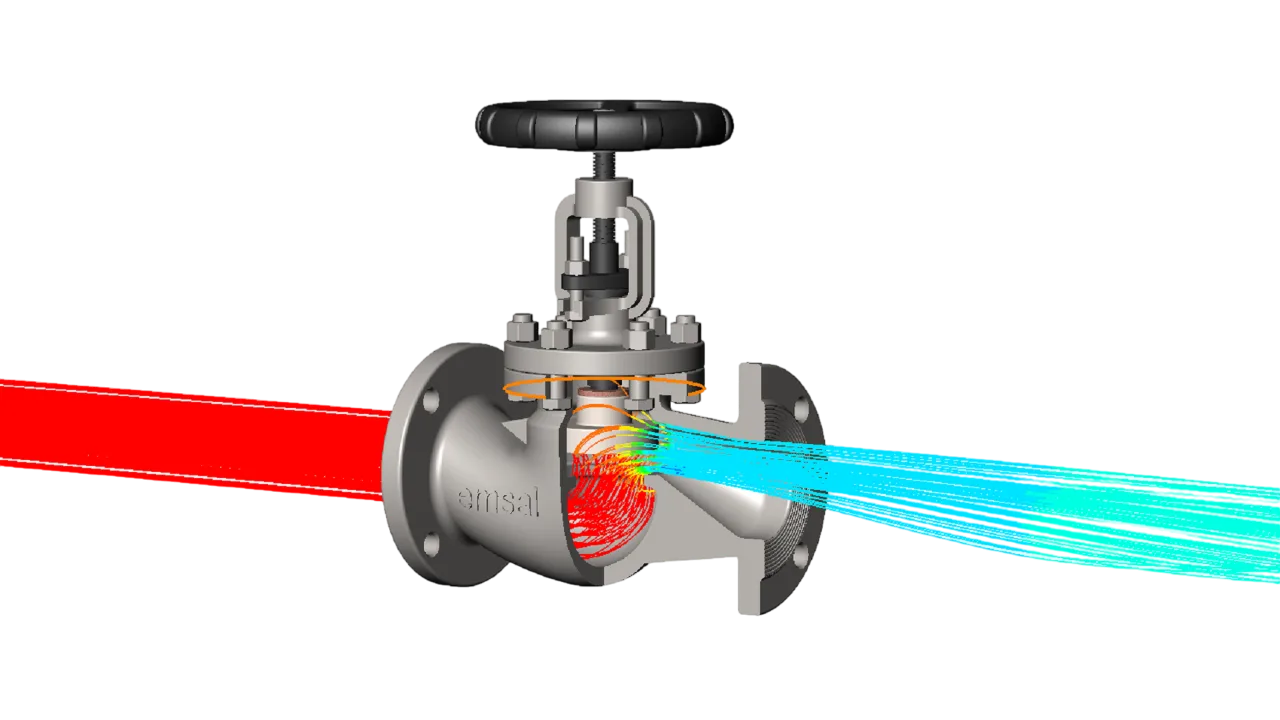
Valves control the flow of liquids and gases, so making them efficient, safe and effective matters greatly in industrial applications. This is exactly where computational fluid dynamics (CFD) comes in. So what is CFD, and why is it so important in valve manufacturing?
What is CFD?
Computational fluid dynamics (CFD) is an engineering discipline that uses computer simulation to solve problems in fluid mechanics and heat transfer. CFD analyses and visualises the behaviour and interactions of fluids using mathematical models, making complex flow problems easier to understand.
The role of CFD in valve manufacturing
- Design optimisation: CFD helps optimise valve designs. When a new valve is developed, flow simulations are used to find the best design parameters, which speeds up the design process and reduces costs.
- Performance analysis: CFD is used to evaluate valve performance. Flow velocity, pressure distribution, turbulence and other factors are analysed in simulation, so real-world performance can be predicted more accurately.
- Safety and durability: CFD is a key tool for making valves safer and more durable. Flow analysis helps identify potential wear points, pressure build-up and other risks in advance, leading to safer, longer-lasting valves.
- Energy efficiency: energy efficiency is an important factor in industrial processes. CFD helps optimise valves to reduce energy consumption. Getting more performance from less energy lowers operating costs and environmental impact.
Conclusion
Computational fluid dynamics has transformed valve manufacturing. Its benefits for design optimisation, performance analysis, safety, durability and energy efficiency have made it an essential tool for valve manufacturers, and its use in industry is expected to grow further as the technology advances.